

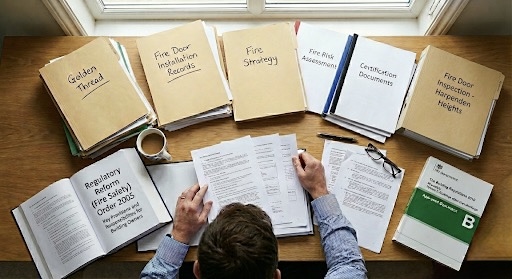
Responsibilities of the Responsible Person in Relation to Fire Doors (UK Legislation)
1. Legal Framework
The duties relating to fire doors arise primarily under:
- Regulatory Reform (Fire Safety) Order 2005
- Fire Safety Act 2021
- Fire Safety (England) Regulations 2022
- Building Regulations 2010
- Building Safety Act 2022
Together, these impose statutory duties on the Responsible Person (RP) regarding the provision, inspection, maintenance, and management of fire doors.
2. Definition of the Responsible Person
Under Article 3 of the Regulatory Reform (Fire Safety) Order 2005 (RRFSO), the Responsible Person is:
- The employer (in workplaces),
- The person with control of the premises (e.g., landlord, freeholder, managing agent), or
- The owner where no employer is present.
Liability rests with the RP even where tasks are delegated (Article 5(3), RRFSO).
3. Fire Risk Assessment Duties
Article 9 – Regulatory Reform (Fire Safety) Order 2005
The RP must carry out a suitable and sufficient fire risk assessment.
In relation to fire doors, this includes assessing:
- Adequacy and location of fire doors
- Fire resistance performance (e.g., FD30, FD60)
- Presence and condition of self-closing devices
- Smoke seals and intumescent strips
- Door/frame gaps
- Damage or alterations
The Fire Safety Act 2021 clarified that, in multi-occupied residential buildings, the assessment must include:
- Flat entrance doors (where they separate domestic premises from common parts)
- Structure and external walls
4. Provision and Installation of Fire Doors
Building Regulations 2010 – Approved Document B
Under Regulation 7 and Schedule 1 (Requirement B1), building work must ensure:
- Adequate means of escape
- Fire resistance within compartmentation
Fire doors must:
- Be suitable for their location and fire strategy
- Meet required fire resistance standards
- Be installed in accordance with manufacturer specifications
Failure to install compliant fire doors may constitute a breach of Building Regulations and, where relevant, Article 8 (general fire precautions) of the RRFSO.
5. Maintenance Obligations
Article 17 – Regulatory Reform (Fire Safety) Order 2005
The RP must ensure that fire safety facilities and equipment are:
- Maintained in an efficient state
- In efficient working order
- In good repair
Fire doors fall within the definition of fire safety measures under Article 4.
Maintenance obligations include ensuring:
- Self-closers operate effectively
- Doors fully close into frames
- Hinges and ironmongery are secure
- Intumescent strips and smoke seals remain intact
- No unauthorised alterations compromise fire resistance
Failure to maintain fire doors has resulted in enforcement action and prosecution in numerous cases under Article 17.
6. Specific Duties for Residential Buildings (England)
Fire Safety (England) Regulations 2022
For buildings over 11 metres in height, the RP must:
- Undertake annual checks of flat entrance fire doors (Regulation 10)
- Undertake quarterly checks of communal fire doors
- Use best endeavours to gain access to flats
- Provide residents with information about the importance of fire doors
Failure to comply is a criminal offence under Regulation 17.
7. Competent Persons
Article 18 – Regulatory Reform (Fire Safety) Order 2005
The RP must appoint one or more competent persons to assist in undertaking preventive and protective measures.
This applies to:
- Fire risk assessors
- Fire door inspectors
- Installation and maintenance contractors
Competence requires sufficient training, experience, and knowledge.
8. Record Keeping
Where the premises employ five or more employees, or where premises are licensed or residential buildings covered by the 2022 Regulations, the RP must record:
- Fire risk assessments
- Inspection regimes
- Maintenance actions
- Identified defects and remedial works
For higher-risk buildings under the Building Safety Act 2022, records contribute to the “golden thread” of building safety information.
9. Enforcement and Penalties
Enforcement authorities (usually the local Fire & Rescue Authority) may issue:
- Alterations Notices (Article 29, RRFSO)
- Enforcement Notices (Article 30)
- Prohibition Notices (Article 31)
Non-compliance may result in:
- Unlimited fines
- Up to 2 years’ imprisonment (Article 32)
- Prosecution of directors or managers where offences are committed with consent, connivance, or neglect (Article 37)
10. Summary of Core Legal Duties
The Responsible Person must:
- Conduct and review a suitable fire risk assessment (Art. 9 RRFSO)
- Provide compliant fire doors in accordance with Building Regulations
- Maintain fire doors in efficient working order (Art. 17 RRFSO)
- Arrange annual and quarterly checks where required (FSER 2022)
- Appoint competent persons (Art. 18 RRFSO)
- Keep appropriate records
- Act on identified deficiencies without delay
Fire doors are statutory life-safety measures forming part of a building’s compartmentation and means-of-escape strategy. Failure to manage them properly constitutes a criminal breach of fire safety law.